

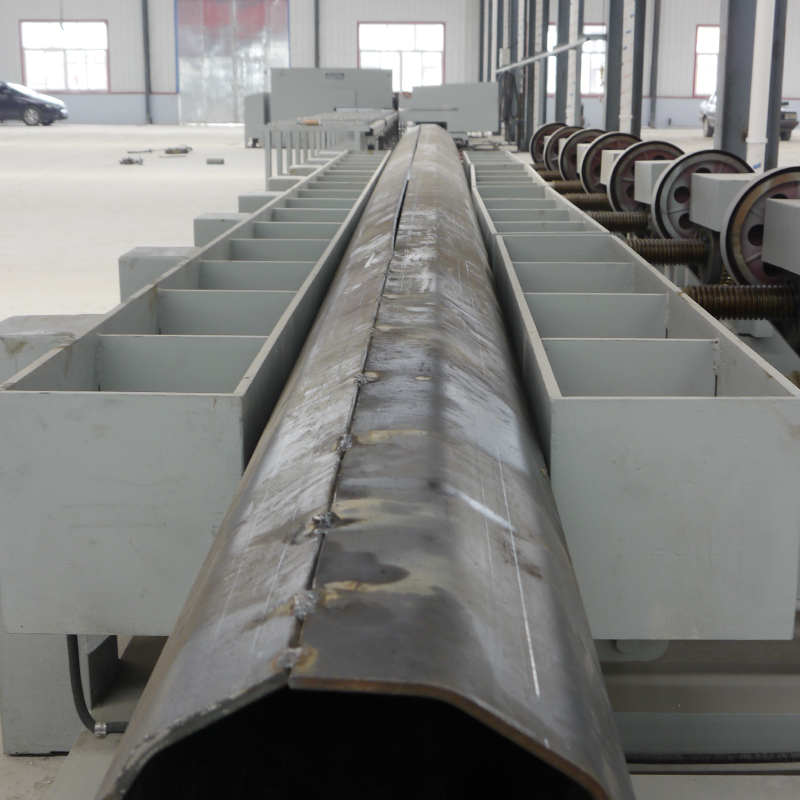
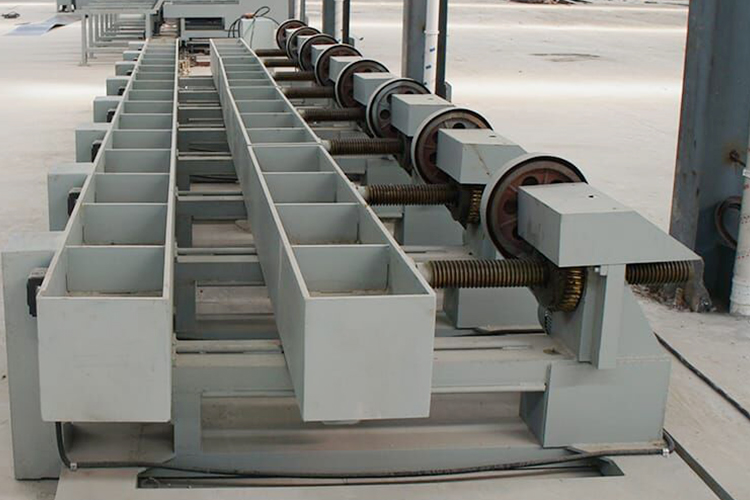
To enhance straight-line accuracy, precise identification of pole deviation characteristics is essential, which relies on the detection system of the straightening machine. Traditional manual inspection methods, such as wire tensioning and ruler checks, are not only inefficient but also struggle to detect minor deviations and complex distortions. Modern pole straightening machines typically employ non-contact or contact multi-dimensional detection devices, including laser displacement sensors, electronic theodolites, or encoder-linked measurement mechanisms. These systems can collect cross-sectional center coordinates or busway straightness data at multiple points along the pole's length, thereby constructing a three-dimensional deviation model of the pole's axis.Cutting Equipment, Welding Equipment,Straightening Equipment,straightening machines
The core value of the detection system lies in transforming "fuzzy curvature" into "quantifiable data." Through real-time data collection, it analyzes deviation types (e.g., unidirectional bending, S-shaped curvature, or helical distortion), locations (e.g., root, middle section, or tip), and magnitudes (e.g., large deviation values, slope variations). When transmitted to the control system, algorithms calculate theoretical force magnitudes, directions, and application sequences for each correction point based on material mechanical properties (e.g., elastic modulus, yield strength) and target straightness requirements. For instance, rod bending at the root requires concentrated application of counter-bending moments near the base, while mid-section bending necessitates symmetrical force distribution around the midpoint to achieve a "three-point bending" correction pattern. This closed-loop feedback mechanism of "detection-analysis-decision" shifts straightening processes from "trial-and-error experimentation" to "data-driven optimization," establishing an informational foundation for precision enhancement.